
Supporto alla didattica
Students will have achieved a more structured understanding of the English language by identifying and using verb tenses and grammatical structures correctly, will have expanded their vocabulary knowledge through the use of word families and phrasal verbs
The exam is written and lasts 45 minutes. There are 30 questions. Students are awarded a pass with a score between 18 and 30. The exam reflects the course syllabus The exam reflects the course syllabus with five different exercises: 1. word formation 2. vocabulary 3. phrasal verbs 4. verb formation 5. multiple choice
English File Intermediate Fourth edition and English Grammar in Use (intermediate) by Raymond Murphy Fifth Edition
| Attachment | Size |
|---|---|
| 343.92 KB | |
| 332.1 KB |
Students will have achieved a more structured understanding of the English language by identifying and using verb tenses and grammatical structures correctly, will have expanded their vocabulary knowledge through the use of word families and phrasal verbs
The exam is written and lasts 45 minutes. There are 30 questions. Students are awarded a pass with a score between 18 and 30. The exam reflects the course syllabus with five different exercises: 1. word formation 2. vocabulary 3. phrasal verbs 4. verb formation 5. multiple choice
English File Upper-Intermediate Fourth Edition and English Grammar in Use (B1-B2) by Raymond Murphy Fifth Edition
| Attachment | Size |
|---|---|
| 332.78 KB | |
| 209.02 KB |
Avvisi
Certificazioni linguistiche:
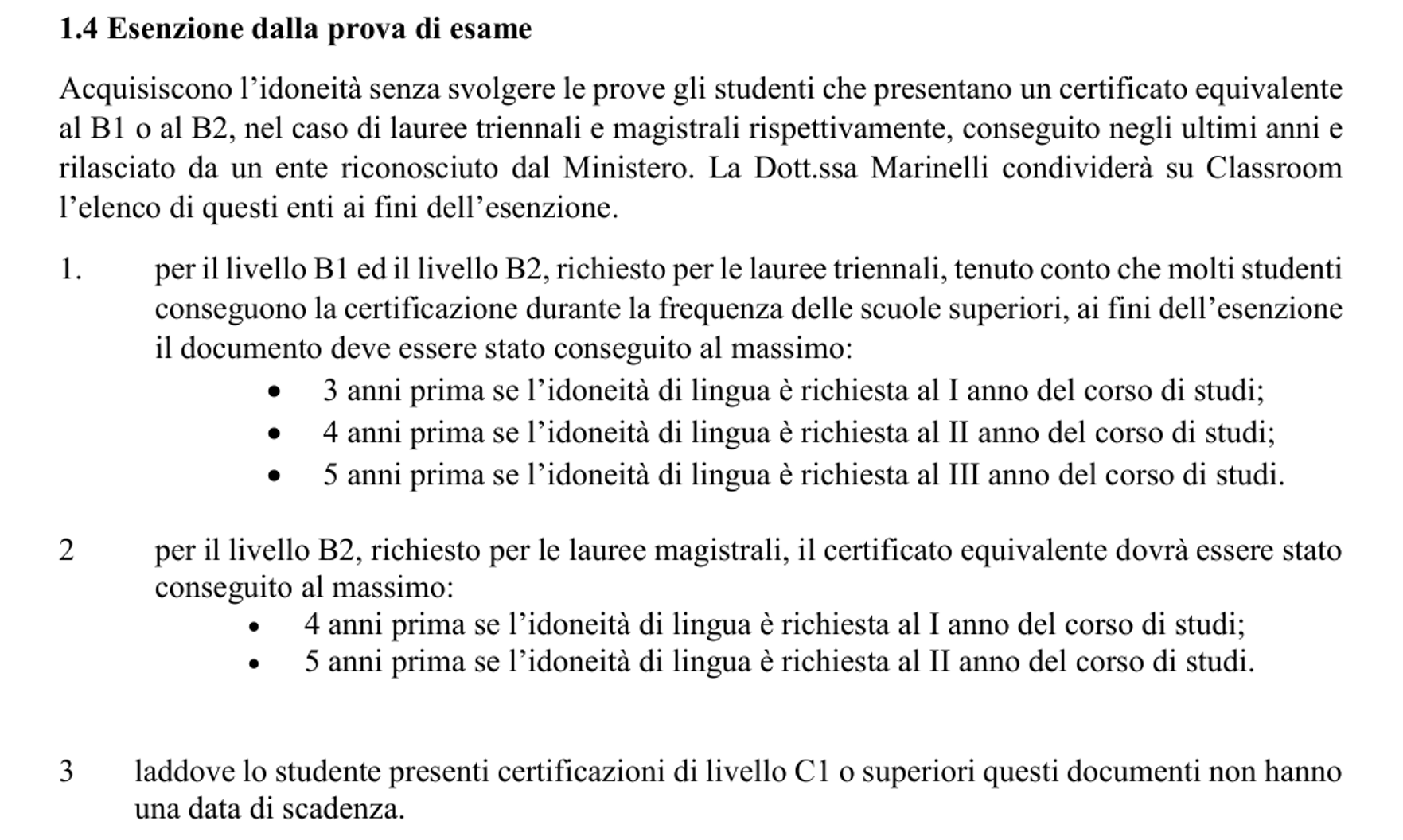
Per la L-32 in Scienze Naturali (Dipartimento di Scienze della Terra) , gli studenti possono caricare nella cartella Drive compilando il modulo Google a questo link ossia: https://forms.gle/5YuALXNjfgUPyJsj8 Per ogni dubbio, possono fare riferimento alla nostra Segreteria didattica: didattica.dst@uniroma1.it
Gli studenti iscritti ai corsi del Dipartimento di Chimica possono inviare le loro certificazioni compilando il Google form a questo link:
https://docs.google.com/forms/d/e/1FAIpQLSc72HzhB2jiOLtDR0oUB4RUV-soI2eQluUYY2j8VjubzIl69Q/viewform
Link dove caricare le certificazioni di inglese per Scienze Matematiche per l'Intelligenza Artificiale:
https://forms.gle/GipC63WCHkezeDcY7
Prossimi appelli
Gli studenti sono pregati di iscriversi all'appello su Infostud cercando in nome del Professor verbalizzante del corso di inglese. Di seguito i nominativi dei professori per corso di laurea:
SCIENZE NATURALI TRIENNALE L-32 (PROF.SSA VALENTINA MASTRANTONIO)
MATEMATICA MAGISTRALE LM-40 (PROF.SSA FLAVIA LANZARA)
MATEMATICA APPLICATA LM-40(PROF. SSA FLAVIA LANZARA)
CHIMICA MAGISTRALE LM-54 (PROF. ENRICO BODO)
CHIMICA ANALITICA LM-54 (PROF. FEDERICO MARINI)
BGIA LM-8 (PROF. SSA DANIELA UCCELLETTI)
SMIA L-35 (PROF.SSA GABRIELLA PUPPO)
MATEMATICA TRIENNALE (PROF. GIACOMO DI GESU')
SCIENZE BIOLOGICHE L-13 (PROF. EMANUELE CACCI)
CHIMICA INDUSTRIALE LM-71 (PROF. MARCO PETRANGELI PAPINI)
CHIMICA TRIENNALE (PROF. FABIO RAMONDO)
BENI CULTURALI TRIENNALE ( PROF. GABRIELE FAVERO)
BAAI L-2 (PROF. MARTINO LUIGI DI SALVO)
- (APPELLO STRAORDINARIO) 4 NOVEMBRE 2026 AULA BOVET EDIFICIO CU026 ORE 8.30-14 PER FISICA TRIENNALE, CHIMICA INDUSTRIALE, SCIENZE BIOLOGICHE E FISICA MAGISTRALE.
- (APPELLO STRAORDINARIO) 4 NOVEMBRE 2026 AULA MONTALENTI CU022 DALLE ORE 16 PER SMIA, BAAI, SCIENZE AMBIENTALI,CHIMICA TREINNALE, BENIC ULTURALI TRIENNALE, MATEMATICA TRIENNALE.
- (APPELLO STRAORDINARIO) 5 NOVEMBRE 2026 AULA C EDIFICIO CHIMICA CANNIZZARO CU014 DALLE ORE 12 PER MATEMATICA MAGISTRALE E APPLICATA, CHIMICA MAGISTRALE, CHIMICA ANALITICA, BGIA, SCIENZE NATURALI
- 18 GENNAIO 2027 AULA 7 EDIFICIO FERMI CU033 DALLE ORE 9 PER PER FISICA TRIENNALE, CHIMICA INDUSTRIALE, SCIENZE BIOLOGICHE E FISICA MAGISTRALE.
- 20 GENNAIO 2027 AULA CABIBBO CU033 DALLE ORE 9 PER SMIA, BAAI, SCIENZE AMBIENTALI,CHIMICA TREINNALE, BENI CULTURALI TRIENNALE, MATEMATICA TRIENNALE.
- 21 GENNAIO 2027 AULA CABIBBO CU033 DALLE ORE 9 PER MATEMATICA MAGISTRALE E APPLICATA, CHIMICA MAGISTRALE, CHIMICA ANALITICA, BGIA, SCIENZE NATURALI
- 1 FEBBRAIO 2027 AULA MAJORANA EDIFCIO FISICA MARCONI CU013 DALLE ORE 9 PER FISICA TRIENNALE, CHIMICA INDUSTRIALE, SCIENZE BIOLOGICHE E FISICA MAGISTRALE.
- 3 FEBBRAIO 2027 AULA CABIBBO CU033 DALLE ORE 9 PER SMIA, BAAI, SCIENZE AMBIENTALI,CHIMICA TREINNALE, BENI CULTURALI TRIENNALE, MATEMATICA TRIENNALE.
- 5 FEBBRAIO 2027 AULA CABIBBO CU033 DALLE ORE 9 PER MATEMATICA MAGISTRALE E APPLICATA, CHIMICA MAGISTRALE, CHIMICA ANALITICA, BGIA, SCIENZE NATURALI